
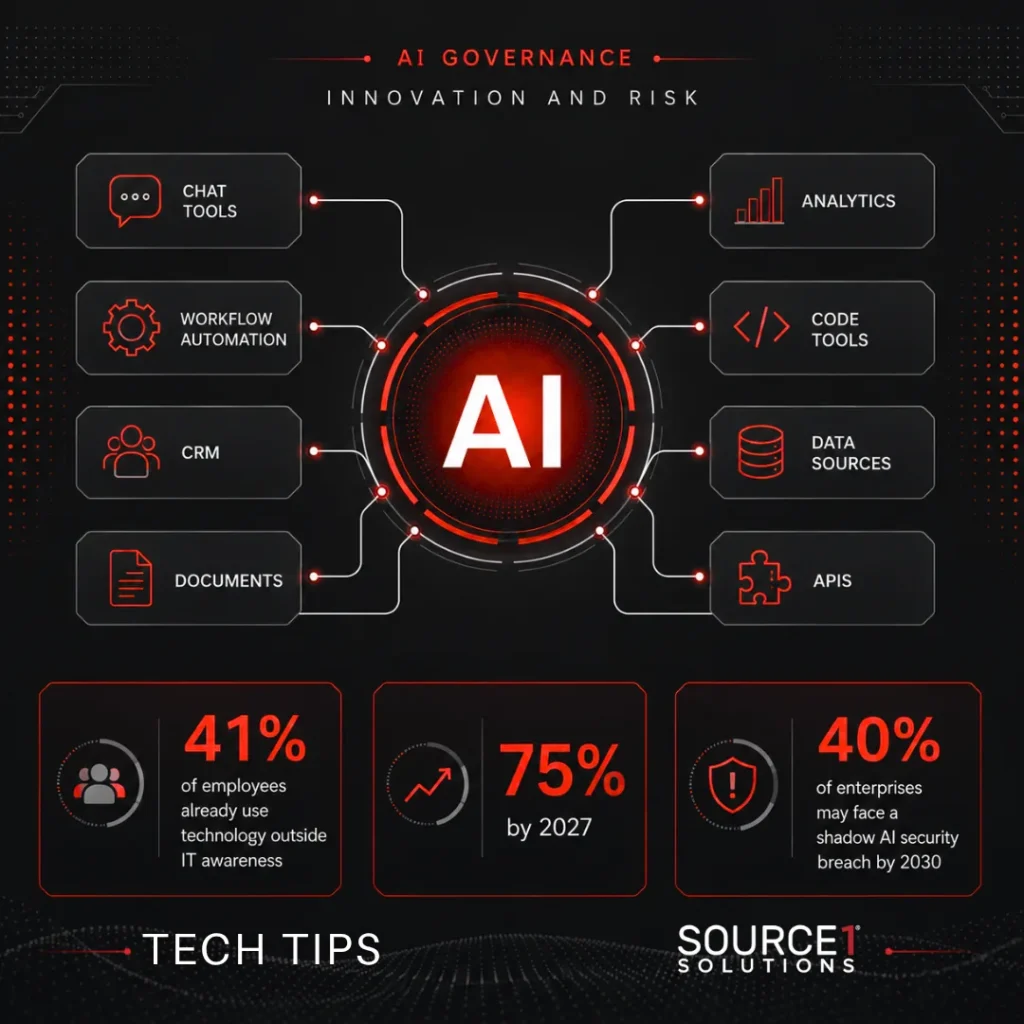
Shadow AI enterprise governance has moved from a future planning concern to a present operational requirement. According to a 2026 Cloud Security Alliance report, 82 percent of organizations discovered at least one AI agent or automated workflow in the past year that their security or IT teams did not previously know existed. Sixty-five percent experienced an AI agent security incident within that same period : and every organization that experienced an incident reported real business impact, most commonly data exposure.
The question is not whether AI tools are running in your environment without IT authorization. They are. The question is whether your organization has built the governance layer to manage them : or whether you are running uncontrolled exposure across every team that adopted an AI writing assistant, an automation platform, or an AI-connected integration without going through IT.
Why Shadow AI Enterprise Governance Is Different From Shadow IT
Shadow IT created governance challenges when employees adopted unauthorized SaaS applications. Shadow AI creates those same challenges at a fundamentally different risk level.
A shadow SaaS application creates an unmanaged data silo and a potential compliance gap. A shadow AI tool processes your organization’s data through a third-party model with its own data retention policies, potentially uses that data to train future models, and creates API connections with broad access to your core business systems : all without any visibility from your security team.
According to Cloud Security Alliance 2026 research, 54 percent of shadow AI tools have been used to process sensitive company data. Seventy-six percent fail to meet SOC 2 compliance standards. Gartner projects that 40 percent of enterprise applications will integrate task-specific AI agents by end of 2026, up from less than 5 percent in 2025. Just 36 percent of companies have formal AI governance frameworks in place, and only 29 percent regularly audit AI usage across teams. The gap between AI adoption speed and AI governance maturity is where breach exposure accumulates.
The Three Categories of Shadow AI Security Risk
Data exposure. When an employee uses an unsanctioned AI tool to process client proposals, regulated health data, or financial records, that content is transmitted to a third-party model provider with its own retention and training practices. The organization cannot audit what was shared, cannot retrieve it, and cannot demonstrate compliance with data handling obligations if the exposure is later discovered. NIST AI Risk Management Framework, HIPAA, CMMC 2.0, and SOC 2 Type II all require organizations to document and control AI tool access to covered data. Regulators are beginning to enforce against organizations that cannot provide that documentation.
Credential and permission sprawl. AI automation tools require OAuth connections and API keys. Deployed outside IT oversight, they accumulate permissions across CRMs, document management platforms, and communication tools that are never tracked, never audited, and never revoked when the employee who created them leaves. This creates standing access that security teams cannot account for and that attackers can exploit long after the original user has departed the organization.
Incident response blindness. When a breach involves an AI tool that security never knew existed, the team cannot determine the blast radius, preserve relevant evidence, or communicate accurately about what was exposed. The Cloud Security Alliance found that organizations experiencing shadow AI security incidents in 2026 consistently struggled to quantify impact because they lacked visibility into the tool’s data access history and transmission patterns. Undefined scope turns what might be a contained incident into a prolonged, expensive response.
What Enterprise AI Governance Looks Like in Practice
An enterprise AI governance program applies the same operational disciplines used for any other IT governance domain. The specific components that HIPAA compliance, NIST AI RMF, and SOC 2 auditors look for include the following.
Discovery and inventory. Every AI tool in use across the organization is identified : including department-level subscriptions and individual employee tools : with documentation of who uses each tool and what data categories it processes. Without this inventory, governance is not possible, and the gap between what IT knows about and what is actually in use is typically large.
Data classification alignment. Each AI tool is evaluated against the organization’s data classification policy. Tools processing regulated data require specific controls, specific contractual terms with the vendor, and documented evidence of compliance. Tools that cannot meet those requirements are prohibited for use with covered data categories.
API and OAuth lifecycle management. Every AI integration that creates an API connection or OAuth token is inventoried, approved, and tied to a specific owner in the employee offboarding process. When that employee leaves, the connection is revoked. This closes the standing access gap that shadow AI deployments create at scale.
Acceptable use policy. The organization defines which AI tools are approved for which use cases, what data types are permitted in each tool, and what constitutes prohibited use. The policy must be specific enough to be enforceable and communicated to employees with sufficient clarity that they can apply it to new tools before adopting them.
Monitoring and enforcement. Network and endpoint visibility is extended to capture AI tool usage, alert on the use of unapproved tools with sensitive data, and detect API tokens generating unusual access patterns or data transfers to AI endpoints outside normal operating parameters.
The MSP’s Role in Enterprise AI Governance
Most organizations do not have the internal capacity to build and maintain an AI governance program while simultaneously managing IT operations, cybersecurity, and compliance obligations. This is where a security-led managed IT provider creates direct value.
An MSP with AI governance capability runs the initial discovery process, builds and maintains the AI tool inventory, manages the policy framework, and integrates AI oversight into existing security monitoring. When new tools emerge : and they emerge continuously : the MSP evaluates them against the organization’s data classification requirements before they reach employees. When AI-related incidents occur, the MSP responds with the context needed to contain and remediate effectively.
Gartner projects AI governance spending will reach $492 million in 2026 and surpass $1 billion by 2030. Organizations that establish this governance foundation now are not just managing current risk : they are building the operational infrastructure that makes ongoing AI adoption sustainable as the tooling landscape continues to expand.
Source 1 Solutions: AI-Ready Managed IT and Cybersecurity
Source 1 Solutions provides AI-ready managed IT and cybersecurity services for enterprise organizations across the United States. We help organizations build the governance frameworks that make AI adoption operationally sustainable : from initial AI tool discovery and inventory through policy development, monitoring integration, and compliance documentation for NIST AI RMF, HIPAA, CMMC, and SOC 2.
For organizations that do not know what AI tools are running in their environment, that is the starting point. We run the discovery process, establish the governance baseline, and give your team a clear picture of what is in use, what it has access to, and what needs to change before your next compliance review.