
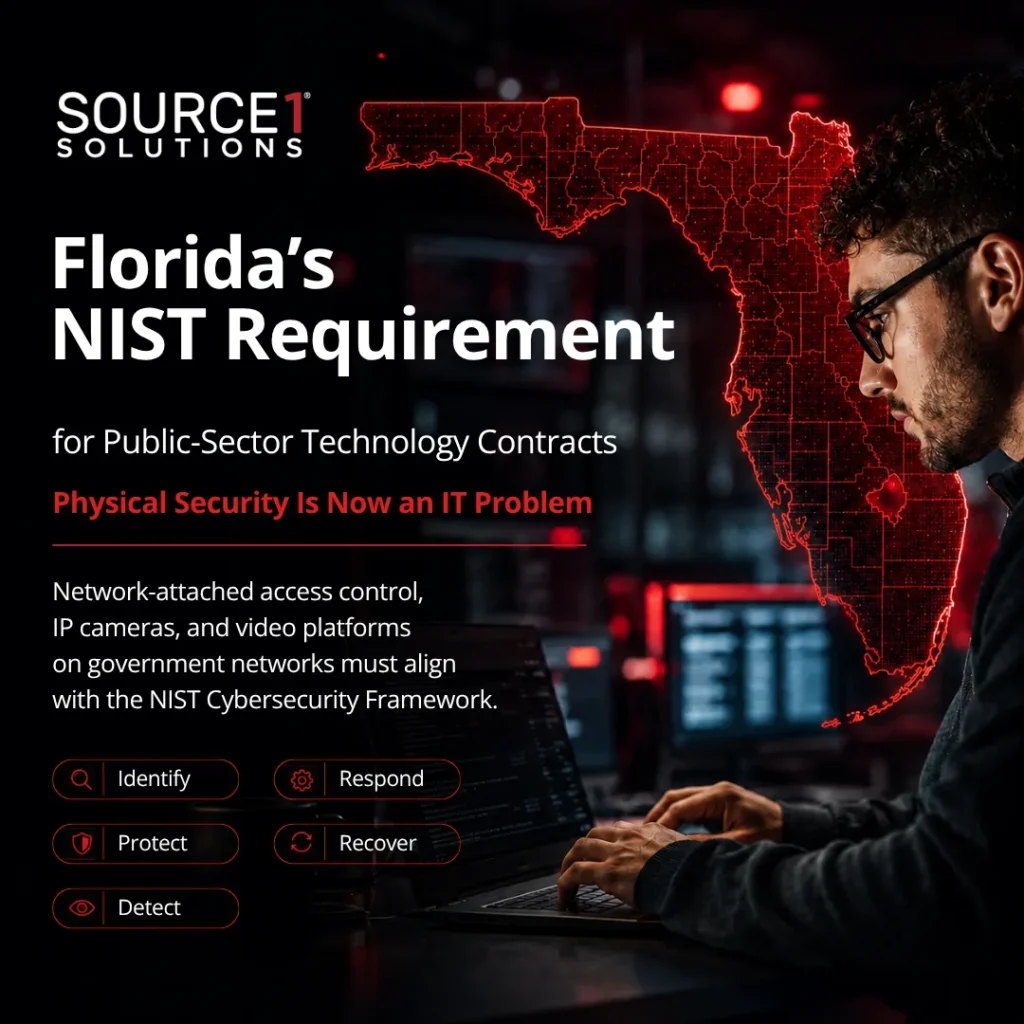
Florida’s state term contracts for technology products and services are required to meet the NIST Cybersecurity Framework. The Florida NIST cybersecurity requirement is not guidance or a best practice. It is a procurement compliance standard that shapes how technology is bought, deployed, and maintained across every Florida public-sector buyer that uses state contracts: county governments, municipalities, school districts, state agencies, water utilities, and special districts.
For physical security professionals, that requirement reaches further than most expected. As access control systems, IP cameras, video management servers, and intercom platforms migrate from proprietary protocols to IP-based, network-attached architectures, they become technology products deployed on government networks. The NIST Cybersecurity Framework applies to them. The same Florida government cybersecurity mandates that govern enterprise IT now govern the security closet.
What the Florida NIST Cybersecurity Requirement Actually Covers
The NIST Cybersecurity Framework is organized around five core functions: Identify, Protect, Detect, Respond, and Recover. Each function contains categories and subcategories that define specific cybersecurity outcomes. Florida procurement officers and state term contract holders are expected to demonstrate alignment with these functions in methodology, not just feature lists. For network-attached physical security systems, the operationally relevant requirements include:
Asset Management (Identify).
Every physical security device connected to the network must be inventoried, categorized, and managed as an IT asset. That means documented firmware versions, network addresses, responsible owners, and lifecycle status. A camera without an owner in your asset register is a NIST gap.
Access Control (Protect).
Logical access to physical security management platforms must follow the same authentication, authorization, and accounting principles as any other IT system. Multi-factor authentication, role-based access, and audit logging are expected. Default credentials on a video management server fail this category on the first audit question.
Continuous Monitoring (Detect).
Network traffic to and from physical security devices should be monitored for anomalies. Security event logs from access control panels and video systems should be collected and reviewed inside the organization’s broader security monitoring program, not siloed in a separate dashboard the facilities team checks twice a year.
Incident Response (Respond).
The organization’s incident response plan must cover physical security system compromises: a breached access control panel, a hijacked camera feed, a ransomware event that encrypts the VMS. If your IR plan stops at the data center, it does not satisfy the requirement.
Recovery Planning (Recover).
Backup, restoration, and continuity plans must include physical security systems. If access control fails at 2:00 a.m., how fast can it be restored, is the configuration backed up off-device, and what are the manual procedures for building access during the outage? Those answers belong in the runbook before procurement, not after a breach.
How Network-Attached Physical Security Triggers NIST Compliance
Ten years ago, an access control system was a proprietary panel on a dedicated cable run, talking to readers on Wiegand, with no IP traffic anyone in IT cared about. That world is gone. Today’s deployments are IP-based at every layer: cloud-managed door controllers, ONVIF cameras streaming over the LAN, mobile credentials authenticating through cloud directories, and video analytics running on shared compute. The moment a device touches a government network, it falls under the same Florida government cybersecurity mandates as the rest of the technology stack.
That convergence is why the Florida NIST cybersecurity requirement matters operationally. The boundary between physical security and information security has dissolved at the protocol layer. A vulnerable IP camera is a foothold into the network. A misconfigured access control panel is an unmanaged Linux box on the production VLAN. NIST CSF is the framework Florida uses to ensure these devices are governed the way the network demands.
What This Means for Florida Public-Sector Buyers
For county governments, municipalities, school districts, water utilities, and state agencies procuring physical security through state term contracts or competitive solicitations, NIST CSF alignment creates specific obligations.
RFP evaluation criteria should include NIST alignment. When scoring vendor proposals for access control or video surveillance, evaluators should assess whether the vendor’s methodology, deployment practices, and ongoing support demonstrate alignment with NIST CSF functions, not just whether they listed NIST in the executive summary.
Installed systems must be governable. A physical security system that cannot be patched, monitored, or integrated into the IT governance framework creates a NIST compliance gap, even if it functions perfectly from a physical security standpoint. Governability is a buying criterion now.
Maintenance contracts must address cybersecurity. Traditional physical security maintenance covers hardware repair and software updates. NIST-aligned maintenance also includes firmware vulnerability monitoring, security patch deployment on a defined cadence, and incident response coverage for the security technology infrastructure itself.
What This Means for Florida Security Integrators
For physical security integrators bidding on Florida public-sector contracts, the Florida NIST cybersecurity requirement is becoming the single biggest competitive differentiator in evaluations.
Proposals that demonstrate NIST understanding score higher. Generic proposals focused on camera counts, door hardware, and feature matrices are increasingly disadvantaged in evaluations that weight cybersecurity methodology alongside technical capability. The winning proposal speaks NIST in the methodology section, not just the appendix.
Installation practices must align with NIST Protect functions. Network segmentation, credential management, default password elimination, and encryption configuration are expected during deployment, not left as post-installation tasks for the customer’s IT team. The integrator that hardens the system at install wins the renewal.
Ongoing support must include cybersecurity maintenance. Integrators that can provide firmware vulnerability monitoring, patch management, and security event log collection inside their service agreement differentiate themselves from competitors offering hardware-only maintenance. That is the converged service model Florida buyers are evaluating against.
Where the Florida Procurement Compliance Gap Sits Today
The gap between the Florida NIST cybersecurity requirement and current practice is significant. Many public-sector organizations have not yet inventoried their physical security devices as IT assets. Many integrators have not yet rewritten their proposals or operational practices around NIST language. The gap represents a compliance risk for buyers and a competitive opportunity for the integrators prepared to close it first.
Florida’s broader cybersecurity legislation reinforces the direction. Local government cybersecurity training mandates under §282.3185 already require formal cybersecurity training and incident reporting at the workforce level. The procurement-side NIST alignment requirement sits in the same governance posture: cybersecurity is not optional at any layer of the technology stack a public entity buys, deploys, or maintains.
Closing the NIST Alignment Gap
If your organization needs help mapping Florida’s procurement requirements to your network-attached physical security systems, our Procurement Navigator identifies the alignment gaps and the documentation each NIST function requires. Source 1 Solutions delivers converged physical and IT security operations for distributed organizations across Florida and the broader U.S. public sector, and we structure every deployment to survive a NIST CSF review on the day the auditor walks in.